
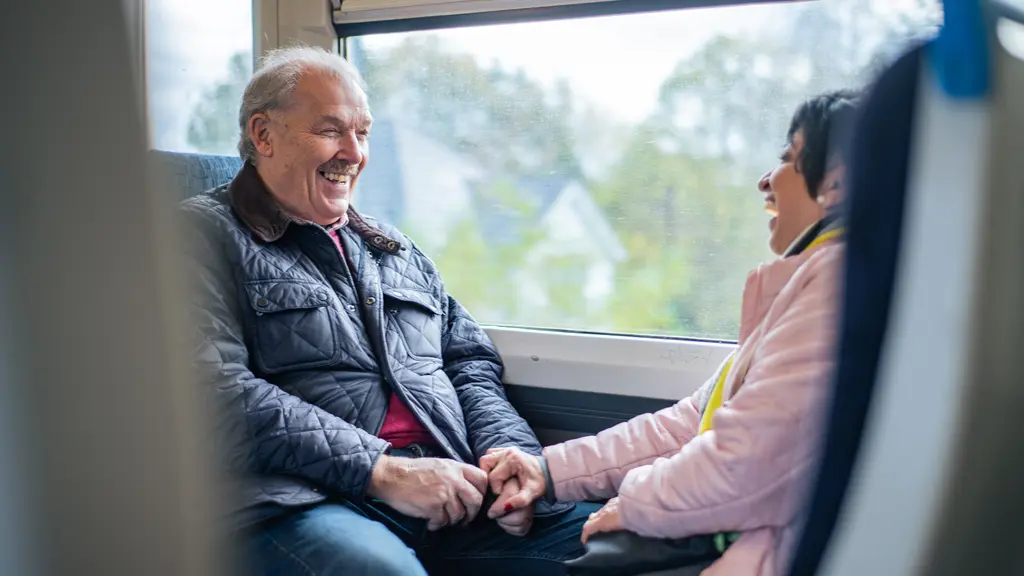
Older, wiser, and looking for love
 11/02/26
Share:




As many singletons will testify, looking for a romantic partner is never easy, and the effort can sometimes seem overwhelming.
But dating in older life need not always be disappointing, and rich experience and wisdom can be invaluable, writes Steve James, Media Officer for the Centre for Ageing Better.
We’re all familiar – through personal experience, chats with friends, stories we’ve read – of the frustrations of dating. And in the 21st century, ‘dating’ is usually accompanied by the word ‘online’.
Many of us appreciate that the more traditional settings where you might meet someone such as pubs, gigs or cafes, offer increasingly reduced hope of emotional attachment – it is so difficult to know who is single in these situations.
That’s not to say it doesn’t happen, but you do have to be lucky. And I speak as a 60-year-old who has taken classes in French, Russian, art, creative writing, golf, various racquet sports, and amateur dramatics. I’ve acquired a few skills and put myself in places where I might meet ‘The One,’ but the only time that the word ‘love’ reared its head was when shouting out a tennis score.
So, once I’d exhausted all the avenues of hobbies and pastimes, the only sensible alternative left, as I discovered, is the online one. That’s not to say that it’s easy, and it takes more than a small degree of courage.
Whatever site you join – and there is a plethora of them out there – taking the first step can seem daunting. And if you’re in your 50s, 60s or older, internalised ageism can make this step even harder. The ‘swipe left/swipe right,’ looks-based platforms make me feel uncomfortable, and I’m sure that many will feel the same.
On a bad day, you can question your desirability, question your looks, question your charisma. Circumnavigating those negative self-perceptions often requires the support of friends and family who may boost your confidence.
And then there's the expectations of what you should have accrued in your life that you could share with a potential new partner. I see profiles where potential romantic connections are seeking "solvent gentlemen only" or "a partner to travel the world with". The Maldives, Seychelles and Tuscany are frequently mentioned.
Forty plus years of hard work has unfortunately not brought me those advantages. Does that mean I have not succeeded at this game of life? It’s certainly not through lack of effort on my part.
But if you escape from the cul-de-sac of restrictive ageism, it’s possible to see that your later years can be advantageous.
The fragility of life – and its finite span – become all the more apparent when you are older. You also realise that relationships of all sorts can be fleeting and tenuous, but also contradictory. I now appreciate something I didn’t when I was younger, in that shared political views, shared pastimes and shared careers don’t always make for a perfect match.
This perception can make you appreciate that well-worn adages such as “beauty is skin deep” can ring true. There’s also some merit to the saying “opposites attract.”
Compassion, empathy, emotional intelligence – these are the qualities that are so important, and they are often strengthened through a lifetime experience. I now look back at my 25-year-old self and appreciate that I wasn’t quite as mature and sensible as I thought. I knew an awful lot about nothing and nothing about an awful lot. As you get older, you acquire wisdom.
I like to think that some of life’s dreadful challenges, such as experiencing the loss of my father, one of my brothers, and my mother’s descent into dementia and ultimate passing, have made me a better person. There are few people in their 60s who do not have similar experiences.
More than once, I’ve heard older women say that past a certain age, they feel they become ‘invisible.’ I can testify that older men can feel the same. Flirtatious interactions in the non-online dating ‘real’ world seem a distant memory.
But I can offer some reassurance here. Kindness is an attractive quality and so is courtesy. How someone interacts with hospitality staff or shop workers, for example, conveys a great deal about their personality.
Many older people may also have undue concerns about their history – sometimes uncharitably and unfavourably referred to as ‘baggage.’ Failed and fractured previous relationships, divorce, health problems, caring responsibilities and so on. These all feed into those ageist biases we may hold towards ourselves, or others.
None of these factors should really matter one iota. Who has led a perfect life? We’re all flawed and we all make mistakes. As you advance in years, you should look at the positive attributes a person has – and that includes yourself. Our history makes us what we are. Romantic idealism and unrealistic expectations should be confined to our teenage years and poetry books.
Believe in yourself, and others will too. Let age be your ally, and you never know what opportunities it can present. Maybe this Valentine’s Day, Cupid’s bow will be pointing at you.