
Yo, bias is irrational. In fact, it’s absurd.
 05/05/26
Share:




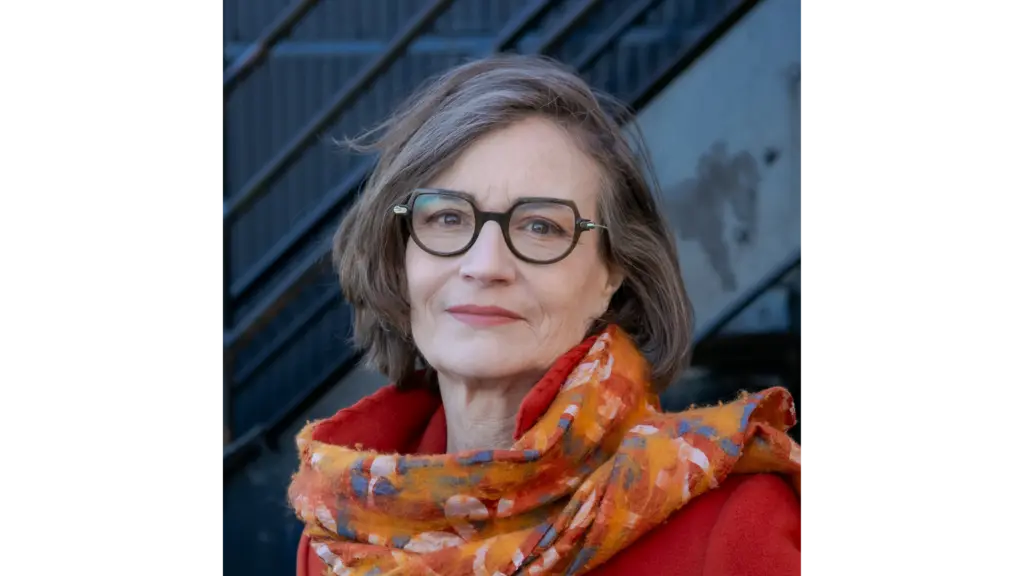
A guest article by Ashton Applewhite, writer, anti-ageism activist and keynote speaker. Ashton is the author of This Chair Rocks: A Manifesto Against Ageism, co-founder of the Old School Hub and the voice of "Yo, Is This Ageist?". Her 2017 Ted Talk, 'Let's end ageism', urged everyone to mobilise against the prejudice around ageing. In 2022, the United Nations named Ashton one of the Healthy Ageing 50: "fifty leaders transforming the world to be a better place to grow older."
When I started writing about ageism, most people hadn’t even heard the word. They didn’t know what it looked like or quacked like, or whether a reference to age might get them in trouble. (Hint: if a similar image or comment based on race or sex would be unacceptable, it’s probably ageist. And just because a card or commercial is funny doesn’t mean it’s harmless.)
The confusion is understandable. To live is to age. It’s a fascinating, powerful, lifelong process every human being embarks on, unless they’re unlucky enough to die young. Nevertheless, mainstream culture portrays ageing-past-youth as something to fear and forestall. No wonder people use euphemisms like “seasoned” or “of a certain age” to avoid the perfectly serviceable “old.” No wonder so many cling to the flotation cushion of “midlife” well past the third turn on the track.
To help the age-curious navigate this loaded landscape, I started a blog called Yo, Is This Ageist? in 2012. (It’s modeled, with permission) on Andrew Ti’s excellent Yo, Is This Racist?) Its Q&A format encourages people to ask me whether something they’ve heard or seen or done is you-know-what. “Happy birthday!” gets a pass, for example, while “Happy birthday, you fossil!” does not. (Hint: avoid assigning a value to a given age and you’ll stay in the clear.)
Scroll through the archive and one thing becomes abundantly clear. Bias makes no sense.
- it relies on stereotypes: the belief that all members of a group are alike in some way. How could that possibly be the case, especially when the group consists of many millions of people born roughly around the same time? Science tells us more variation exists between individual members of a group—Virgos, Chileans, cat-lovers, you name it— than exists between groups, no matter how different those groups may seem. Not to mention the fact that heterogeneity increases with age: the longer we live the more different from each other we become.
- it harms our future selves: Ageism is any judgement on the basis of age, and younger people experience a lot of it. But in a youth-oriented society, older people bear the brunt. Why on earth discriminate against a group we hope to join? No one wants to die young, after all.
- it’s rooted in denial: It doesn’t make sense to go through life pretending something that’s happening to all of us—waking up a day older—is never going to happen to us. Yet that’s how most people behave when it comes to age and ageing. Even though well-being tends to increase with age. Even though no one actually wants to go back to their youth, because no matter how apprehensive we may be, we know that our years make us us.
This irrationality shouldn’t come as a surprise. Most brain activity— a full 95%— is unconscious. So is most bias. The unconscious mind is irrational, emotional, and powerful. It influences judgment, feelings, and behaviour in ways that we’re largely unaware of. We like to think of ourselves as rational beings, acting on the basis of logic and evidence. Yet, no matter how often I type “science tells us,” science also tells us that human brains are wired respond to emotion and narrative, not to abstract facts and data.
No one wants to admit they’re prejudiced, even to themselves. That’s why it takes all the tools in the toolbox to challenge bias—to shine a light on behaviours and attitudes that people may not be conscious of or may be reluctant to acknowledge. That’s why confronting bias calls for creativity and humour in addition to facts and figures. That’s why I like the theme of the latest Age Without Limits campaign: Ageism is Absurd.
The graphics show four adorable children puzzling over sayings that stereotype older people as slow, stodgy, stuck, and obsolete.
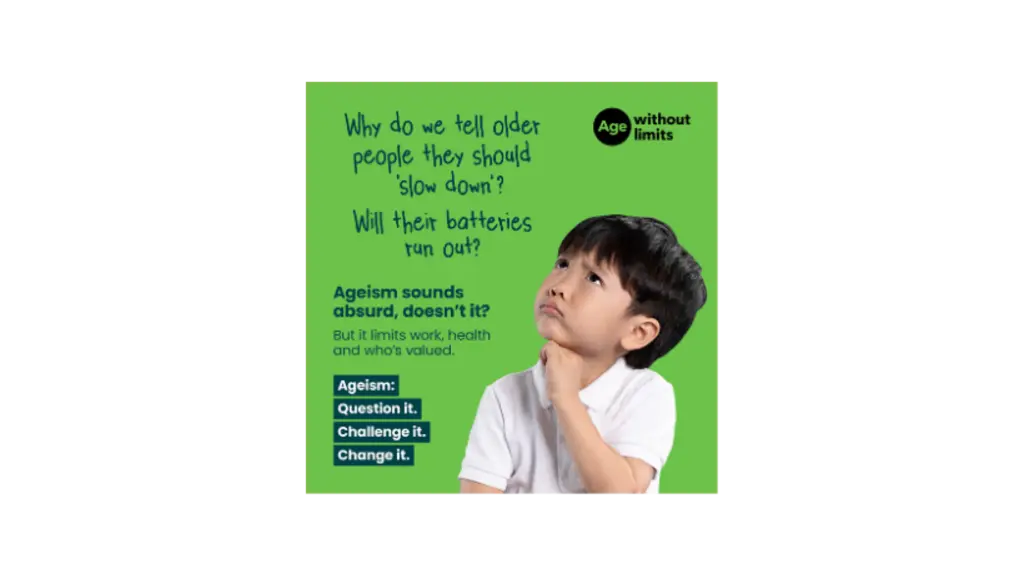
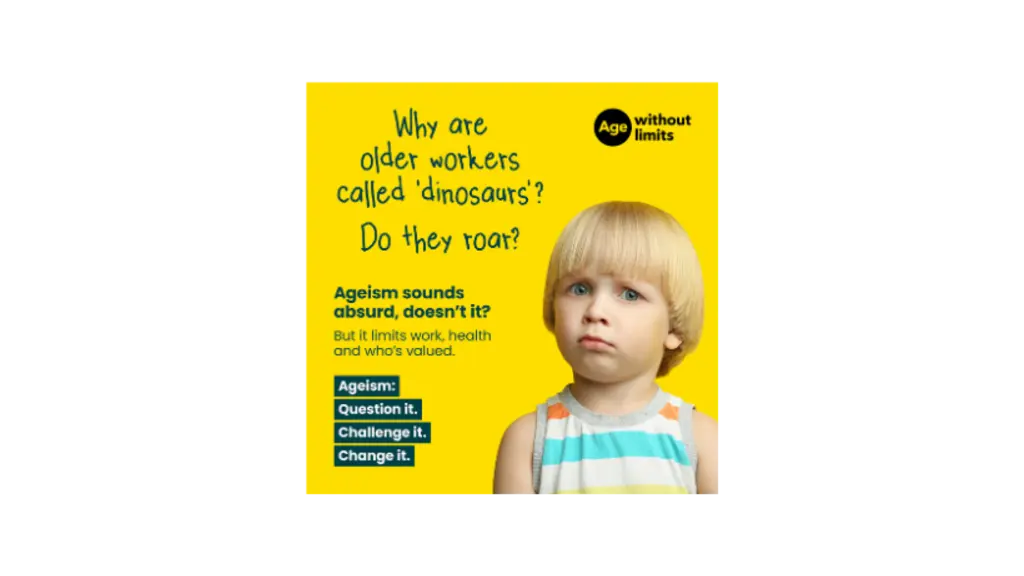
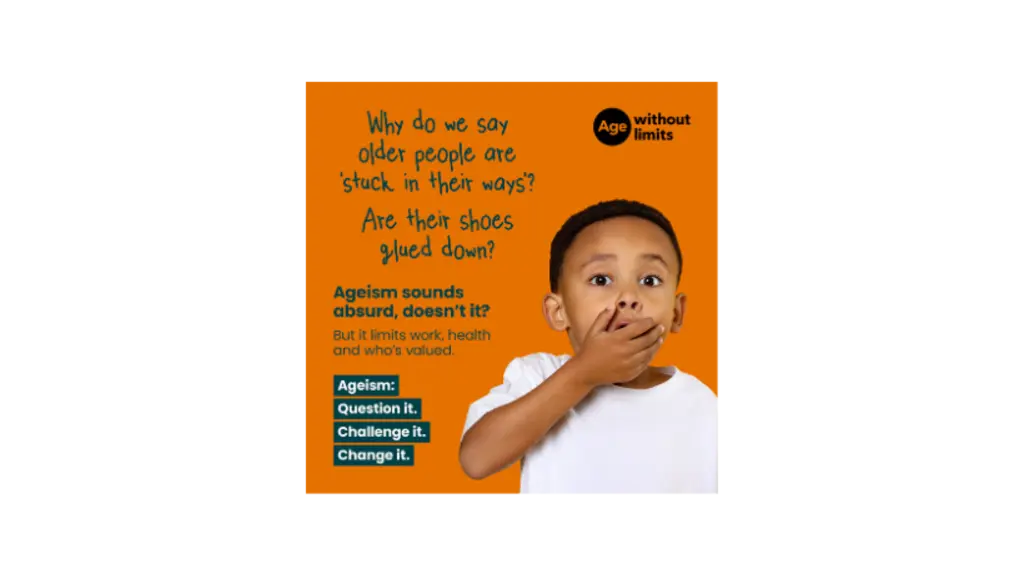
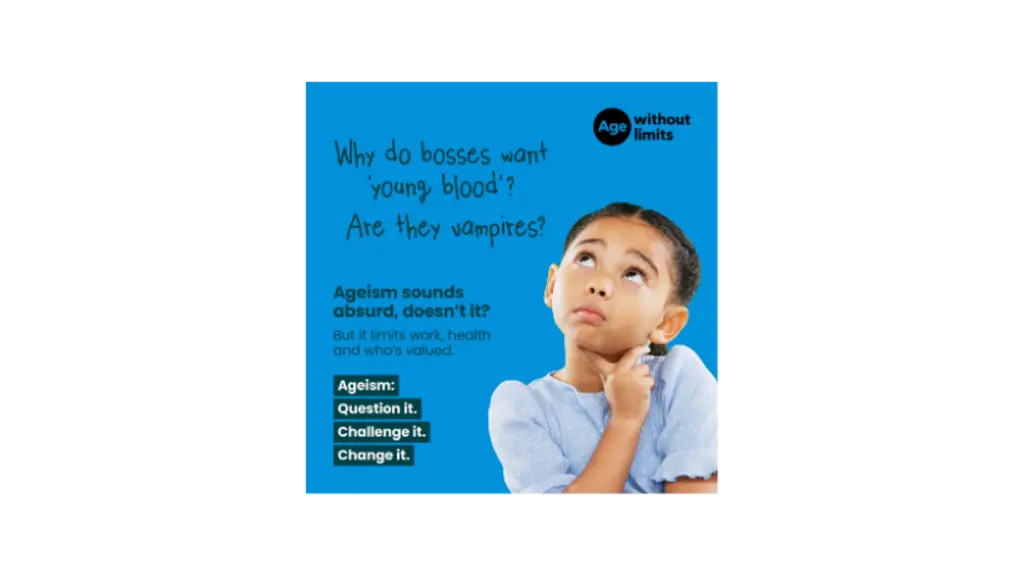
Bias is learned. That process starts early on, as kids absorb the culture around them and learn to conform. But very young children are literal, honest, and perceptive. They call it like they see it, sometimes expressing profound insights that adults have learned to overlook or ignore. In this case, it’s the plain foolishness of age-based caricatures and assumptions.
“Ageism sounds absurd, doesn’t it?” says the text on each graphic. “But it limits work, health, and who’s valued.” There’s nothing absurd about discrimination. From childhood on, we’re bombarded with negative messages about ageing past youth. Unless we stop to challenge them, these messages become part of how we see ourselves, harming our health, our communities, and our place in the world.
The stakes are high. It’s not healthy, individually or collectively, to go through life fearing our futures and alienated from our future selves. Unlearning is hard, especially when it comes to values. But it’s doable, it’s free, and it’s vitally important—especially in a world of longer lives.
The Age Without Limits campaign has an overarching call to action: Ageism: Question it. Challenge it. Change it. You can’t start too late. You can’t start too small. The only mistake is not to start at all.
Banner image: Ashton Applewhite. Credit: Susie Lang.